Posts tagged Special events
Press Release: At Texas A&M, the Curriculum Calls for Collins

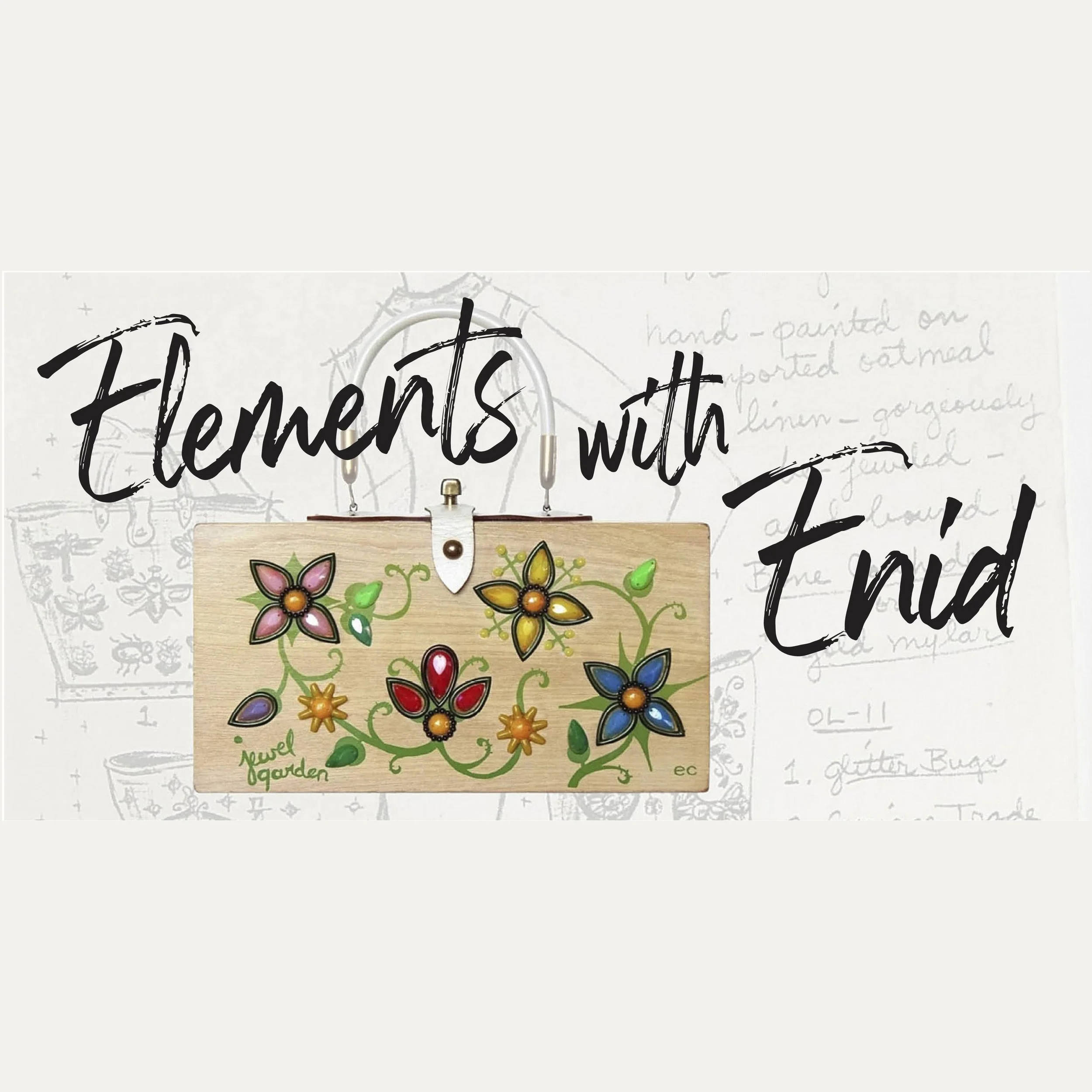
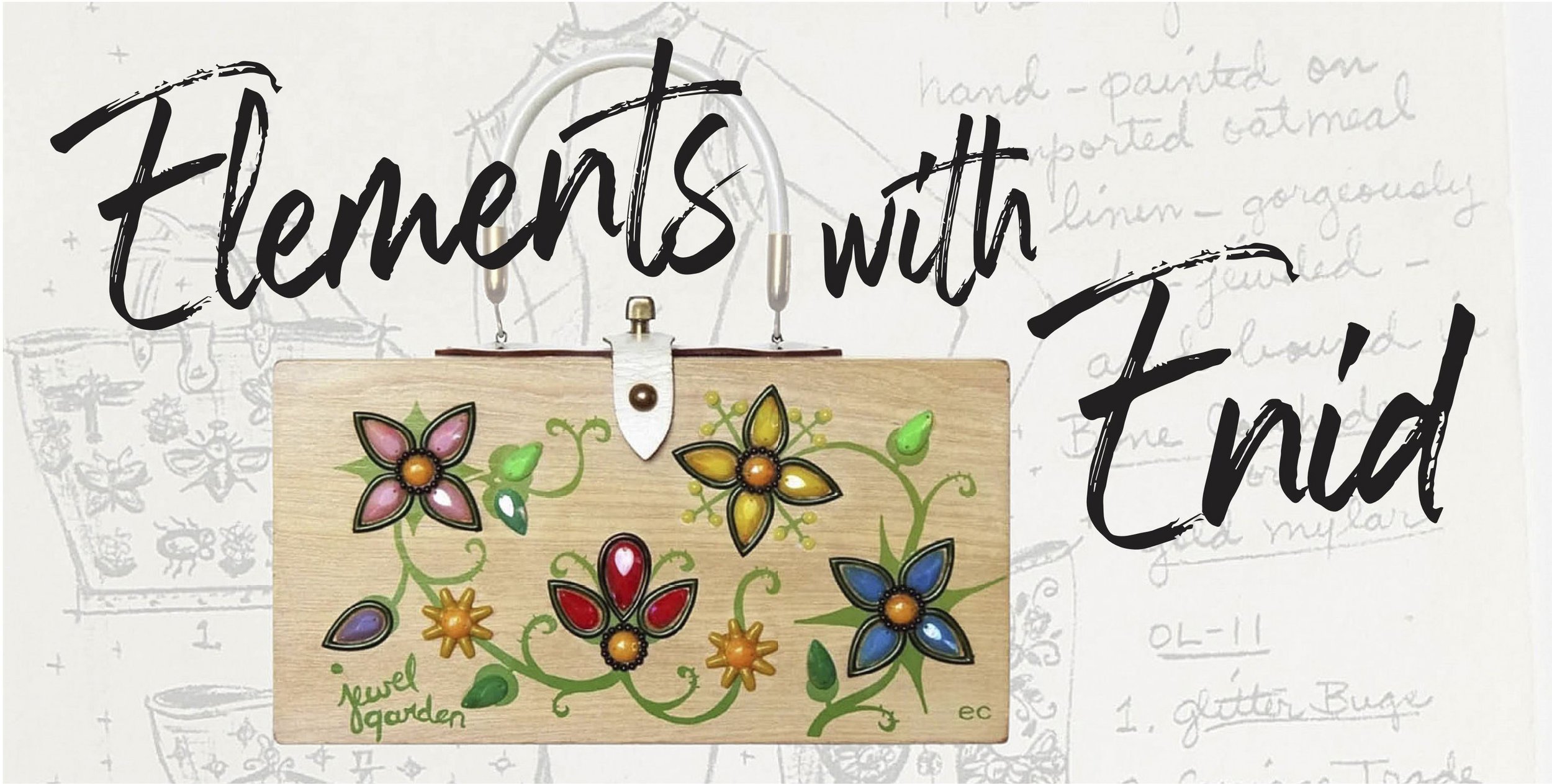
nearly 100 Original Enid Collins bags, accessories and vintage advertising pieces from the Collection travel to College Station, Texas, as part of a visionary floral art student exhibition


COLLEGE STATION, Texas – “College course” conjures up some typical notions for most people.

Tomes of dense reading. Rhetorical essays to draft and revise, and revise, and revise. Hours of hands-on work in a lab or studio to pursue an idea and practice skills under the critical eye of an exacting professor.

But it doesn’t make most of us think, “the study of purses.”

So, when Texas A&M University Asst. Prof. Wendy Osburn called last summer to ask if Finding Enid with Love would be willing to help her design a course around Enid Collins, we were a bit puzzled––not because we don’t see Enid’s work as worthy of academic study. We simply didn’t know what to make of Osburn’s particular discipline: floral design.

Wait. Floral design?

“The first time I heard the idea, it just didn’t make any sense to me,” says Finding Enid with Love Collection Manager and Curator Karen Adler. “I didn’t know that floral design is a serious discipline.”

Osburn directs Texas A&M’s quietly renowned Benz School of Floral Design, a go-to institution for floristry certification and continuing education housed in the university’s horticultural department. It’s also one of a handful of schools in the United States where undergraduates can earn professional certification.

Osburn, whose background encompasses fine art, art education, commercial floristry and ministry, leads the school with an approach that “seamlessly integrates science, structure and artistry into floral design.”

Texas A&M Asst. Prof. Wendy Osburn in the studio with floral design students in 2019.

Osburn wanted to use Enid’s work as a conceptual launchpad for “Horticulture 453: Floral Art,” an advanced course that approaches “floral design as an art form, in contrast to a commercial florist operation, [and stresses] interpretive expression of design principles and color… along with international design styles.”

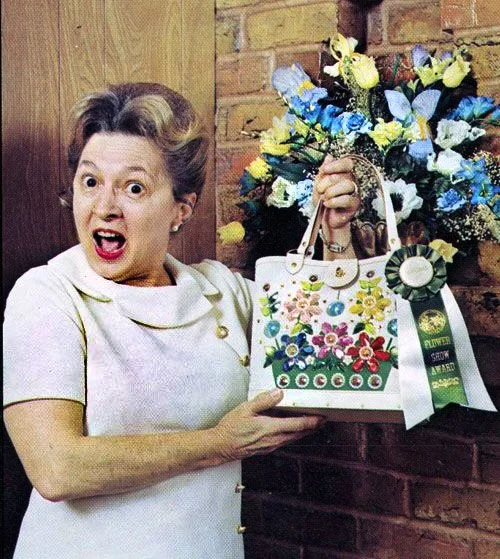
She hit on the idea when a colleague dropped by her office with a vintage “flower box” bag she’d just unearthed on Etsy.

“I was like, ‘Oh my God, I could name all the ladies in church in Bryan [Texas] who had those purses every Sunday,’” Osburn says. “ Being a little girl who was into interiors and color, I always was mesmerized looking at the gems on the purses. I’d be standing up, looking in the pews when I probably should have been praying.”


“flower box” by Enid Collins (undated).


But what on earth would her class be doing? Making purses out of pansies? Stuffing roses into totes?  It’s not hard to imagine fashion students studying Enid’s bags but “who would have thought about flowers?” Adler says.

“I have to explain to students that being a florist is an art career,” says Osburn. “It’s not just shoving flowers in a vase, which is sometimes what our department thinks we’re doing down here. We teach the elements and principles of design. We teach style. We teach theory. We teach about things out in the world. … It’s a different mindset.”

All college students have to attend lectures, hit the books, draft essays and cram for exams. When they study art, they do all of this and more.

The study of fine art requires a grasp of core principles, theories and methods in order to learn how to create representations, to get abstract thoughts out of our heads and onto a page, canvas or, in this case, three-dimensional space.

Osburn’s class studied Enid’s designs to understand seven fundamental art elements: line, form, space, size, pattern, color and texture. Floral art adds a challenging eighth, fragrance. They also studied principles such as balance, proportion, rhythm and unity.

Osburn used photos of hundreds of objects from the collection (plus two of her own Collins box bags) to challenge the class to think about how Enid used art elements to visualize concepts such as “transportation” and “fragrance,” or figurative turns of phrase such as “being a night owl” and “money doesn’t grow on trees.”

While this helped students break down the decision-making process that artists use when creating a piece, it also let them practice the adaptability they’ll need to meet the demands of real-world clients.

Though Osburn had confidence in her students, she admits that she had moments of doubt.

“Sometimes, you’re afraid, ‘Are they going to get what I’m feeling? Can they see the line in this? Can they see the elements of space?’” she says. “It’s a lot of faith. It’s a lot of their trusting me, and me trusting them.”

The students’ first challenge was to create their own box bags in the spirit of Enid.

The first assignment challenged each student to make their own box bag with a donated cigar-box “canvas” and media such as paint and ink, fabric, paper, wire, sequins and plastic jewels.

Next, they worked alone and in groups to design full-scale gallery installations based around each art element and inspired by Enid’s designs.

Working within constraints assigned by Osburn, such as specific color schemes and scale requirements, they crafted exhibits using a wide range of media, from permanent botanicals (the professional term for “artificial flowers”) and spray paint to play money and Popsicle sticks.

Osburn encouraged students to push past limits of what they thought they could achieve and stretch their creativity. “They had to look at all of the purses I chose, then come up with the elements.”

How did it go?

“They grabbed it,” she says. “For the students, this has been amazing. … I’m just so proud of their work.”


The Finding Enid with Love Collection loaned nearly 100 vintage Enid Collins bags and other objects to the Benz School and Texas A&M University Galleries for the culminating student show, "Elements with Enid: a floral perspective exhibition using the elements and principles of floral design to take a fresh look at Enid Collins” as an artist. The exhibition, which opened March 20 in the university’s Lindsay Gallery, includes handbags that span more than 50 years of fashion history and Enid's haute couture designs.

Collection Manager and Curator Karen Adler helps install original Enid Collins bags in the “Color Element” exhibit.

For months leading up to the opening, Adler meticulously prepared each object and assembled information about its artwork, materials and provenance, according to museum standards. She then flew to College Station to help with installation and meet the students. And, of course, to satisfy her curiosity about what Osburn and the budding floral artists had actually made.

“It’s just extraordinary, the talent of these students, the creativity that emerged through Wendy’s vision,” she says. “This exhibit rivals shows I’ve seen in some of the best museums in the U.S. and Europe.”

Students defended their works to a sold-out crowd, including Enid’s son Jeep Collins (third from left) and his family, and former American Institute of Floral Designers (AIFD) Board Vice Chair and Founder of Texas A&M Student AIFD Ken Senter with his wife, Donna (couple at right edge of audience).

Although a painter and former gallery owner, Adler had not closely analyzed Enid’s work for art elements until Osburn flew to Colorado last summer. Over the three days they worked together, Osburn conceiving themes around elements and Adler pulling purses to feed the process, she got a “Collins crash course” that taught her something new about Enid’s work each day (often 12 hours or more).

“I learned so much about the design elements of Enid’s art and came away with an even deeper appreciation for her as a fine artist,” she says, adding that the experience reinforced her appreciation for thinking beyond boundaries.
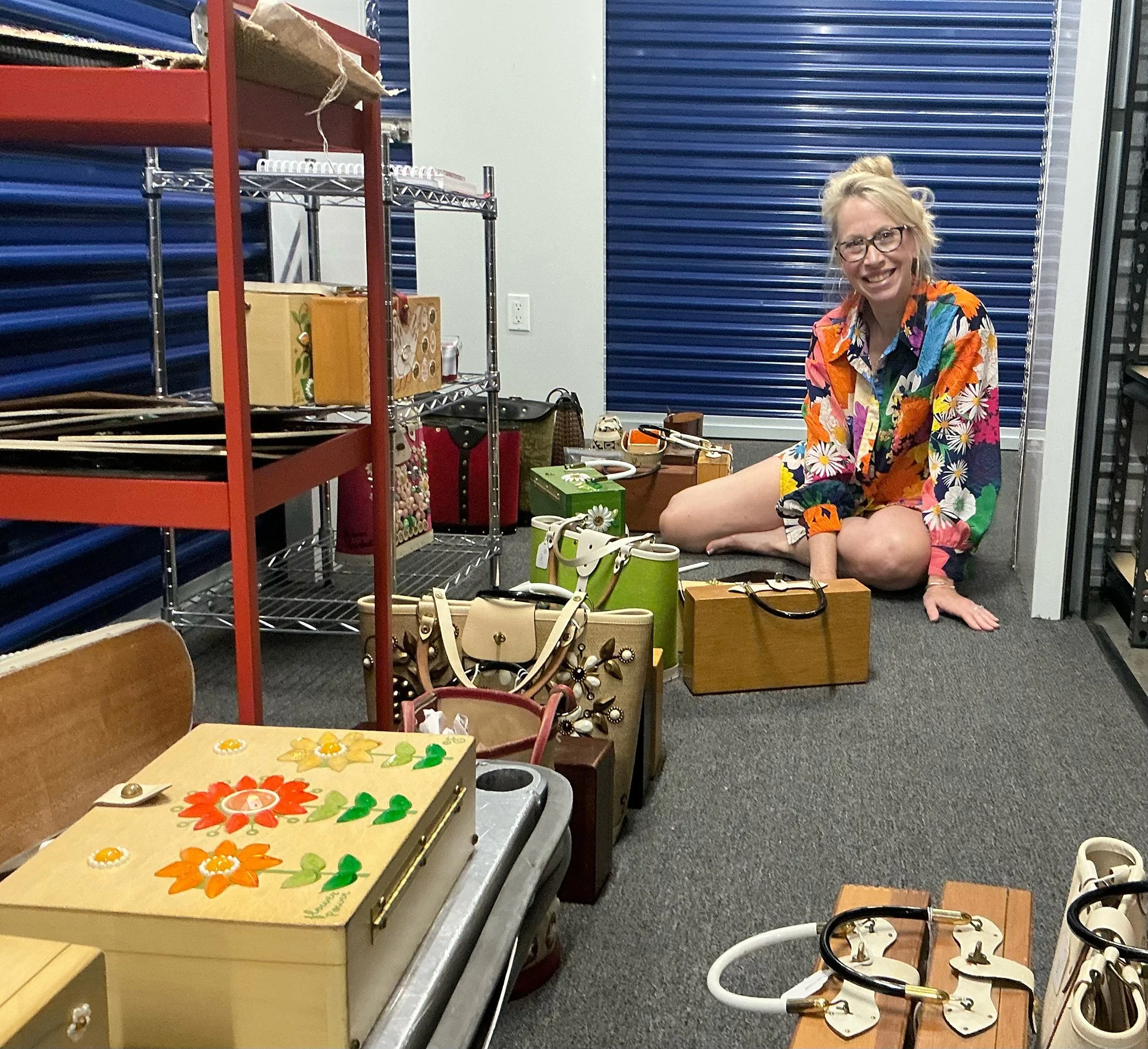
Osburn at work in the Collection in 2025.

“This combination of floral design and Enid’s bags is a great example of how important it is to blur lines, to collaborate and learn from each other across disciplines,” she says. “Something happens when you put two things together that don’t typically belong together. That’s what’s happening here, something new and exciting, because of that intersection.”

It all started with an Etsy find, a phone call from College Station and an inspired teacher.

 “Wendy knew this was a great idea and she just did it,” Adler says. “It shows that Enid’s not stuck in history. Her work is still alive, and this is one way to acknowledge it.”
 

who: Texas A&M Advanced floral Art students and faculty

What: “Elements with Enid” Floral Art Show

When: March 21 through May 10, 2026

Where: Texas A&M University Lindsay gallery at the J. Wayne Stark Galleries, Memorial Student Center rm. 1111 , 275 Joe Routt Blvd., College Station, Texas

Cost: Free

"Elements with Enid:" A Floral Perspective on the Art of Enid Collins at Texas A&M
 

Nearly 100 original Enid Collins bags from the Finding Enid with LOVE Collection are on loan to the Galleries at Texas A&M University.


This advanced Floral Art student exhibition uses the elements and principles of floral design to take a fresh look at mid-century designer Enid Collins, whose haute couture handbags were the pride of Texas for more than 50 years. Show runs through May 10, 2026. Click linked image for more information.


Looking for “LOVE”? Our pop-up store will offer rare chance to shop scores of Enid Collins of Texas vintage bejeweled handbags offline, in person
 

Finding Enid with LOVE will host a “Collinsiana Cabana” pop-up store as part of Arizona Tiki Oasis April 29 in Scottsdale.


Visitors will be able to browse scores of original Mid-Century box bags and totes by Collins of Texas plus a selection of Enid-inspired imitators.


DENVER, Colo. (April 10, 2023)­­­ ­— Anyone who covets the whimsical jewel-adorned vintage handbags created by Mid-Century designer Enid Collins knows that finding even one can be like discovering buried treasure.

Usually, the hunt happens online, as would-be buyers swipe through dubious images on e-commerce platforms, where bags that are rare or in good condition are quickly snatched up, often for hundreds of dollars.

As New York Times Styles Editor Alexandra Jacobs notes in her 2021 article, “Is It Time for an Enid Collins Revival?”, the brilliantly spangled bags that once graced the windows of Saks and Nieman Marcus are now “perfect fits for the photo grids of eBay, Etsy, Pinterest and Instagram.”

But buying them virtually leaves a lot to chance.

Even when lucky enough to score one of the prized pocketbooks, shoppers may be in for a shock when their item arrives.

“Sometimes when I receive bags I’ve ordered online––let’s just say it: it’s a disappointment,” says Karen Adler, a Colorado cultural anthropologist who studies Collins’s work and since 2011 has been building a professional collection of nearly 600 original Collins-designed box bags and more than 200 totes.

“Even if you understand vintage well, there can still be problems you don’t expect because a lot can happen over 60 years,” she explains. “The handle leather is cracked. Latches or hinges are broken. They’re missing jewels. Sometimes, the bag’s not even useable. And there’s that mustiness. What you see online is not what you get.”

Since launching her small social enterprise, Finding Enid with LOVE, a social enterprise Adler has conducted what she calls “purse anthropology” on bags that Collins created from the mid-1950s to 1972. Collecting and studying hundreds of physical artworks using direct observation and other professional methods, she’s become an expert at authenticating Collins works and identifying the deceptively simple-seeming faux-jewel patterns that made the designer famous from small-town Texas to Fifth Avenue.

She’s also helped people identify and replace missing jewels through eBay since 2011 and sold refurbished bags through Etsy since 2013. Highly rated on both platforms, she’s routinely praised for professionalism, knowledge and exceptional levels of quality and care.

As one cheeky reviewer put it, she’s “a ‘gem’ to do business with.”

Now, she’s bringing her glittery goods and expertise to Scottsdale.

To give Collins collectors and others an opportunity to see – and touch and smell –– the real bejeweled-bag deal, Adler will hold a “Collinsiana Cabana” pop-up store as part of Arizona Tiki Oasis, a four-day mega-meet-up of Tiki and Mid-Century style enthusiasts to be held at the end of April at Hotel Valley Ho.

Visitors to the shop will be able to browse scores of original Mid-Century box bags and totes by Collins of Texas, plus a selection of Enid-inspired imitators.

The shop will also offer signed copies of “Enid,” a 2021 memoir by Collins’s son, George Philip “Jeep” Collins, a jeweler based in Fredericksburg, Texas, not far from the family’s former ranch. The book braids excerpts from his mother’s correspondence and journals with personal memories about the curious mix of ranch life and high fashion.

In addition to the sparkle, color and hands-on feel of physical vintage Collins bags, the opportunity to experience so many together in one place is important, Adler notes.

“You almost never see them in bulk like this,” she says, adding that even auctions of collections are mostly held online now. “There’s so much to learn by seeing lots of them together. You get a better understanding of her design process, her worldview and her writing style.”

That experience is what Finding Enid with LOVE is all about, she says, adding that it may also be the secret something behind the Collins craze.  

 “What happened, over and over among those of us who love Enid Collins, is that it started with an accidental discovery of just one bag. But that one spoke to us, told us we had to have it because it was so strange and wonderful. Look at how taken we all were by just a single bag. Can you imagine walking into a whole room of them?”

Finding Enid with LOVE’s “Collinsiana Cabana” pop-up will run 10 a.m. to 4 p.m. April 29 as part of the event’s free, public Marketplace. It will be located in the Cabana Room vending section adjacent to the OH Pool at Hotel Valley Ho, 6850 E. Main St., Scottsdale.

Those holding an Evening Resort Pass, which run from $139 to $299, can shop a special two-hour pre-sale from 4 to 6 p.m. April 28.

Adler will also present “Enid Collins of Texas: Queen of Kitsch?” a one-hour educational seminar looking at the artistry behind the handbag bling, to be held at 2 p.m. April 28 in the hotel’s Soho 2 room.

·      For more information on Finding Enid with LOVE: www.findingenidcollins.com.

·      For Arizona Tiki Oasis Marketplace, seminar and event information and ticketing: www.aztikioasis.com

·      Finding Enid with LOVE on eBay (as manifestART): https://www.ebay.com/usr/manifestart

·      Finding Enid with LOVE on Etsy: https://www.etsy.com/shop/findingENIDwithLOVE?ref=condensed_trust_header_title_reviews


WHAT: Collinsiana Cabana pop-up shop at Arizona Tiki Oasis

WHEN: 10 a.m. to 4 p.m. April 29.

WHERE: Cabana vending section by the OH pool, Hotel Valley Ho, 6850 E. Main St., Scottsdale

COST: free and open to the public

Evening Resort Pass holder pre-sale: 4 to 6 p.m. April 28. passes from $139 to $299

marketplace info: https://www.aztikioasis.com/marketplace

 
Beguiling. Bejeweled. Beloved. How do you know when an old handbag is more than just kitsch? When it feels like love at first sight – even 60 years later.
 

“Purse anthropologist” Karen Adler asks us to consider how clunky, gaudy but enduringly desirable handbags created by Mid-Century designer Enid Collins are more than just eye candy and looks at the artistry behind the bling in her upcoming discussion, “Enid Collins of Texas: Queen of Kitsch?” The one-hour talk, part of the Friday educational seminar line-up at 2023 Arizona Tiki Oasis, will take place at 2 p.m. April 28 at Hotel Valley Ho, 6850 E. Main St., Scottsdale.


Newspaper ad from late 1960s or early 1970s promoting an in-store appearance by Enid Collins, “handbag designer extraordinaire".”


DENVER, Colo. (April 10, 2023)­­­ ­— Have you ever had that feeling?

There you are, in the midst of a dreary everyday or soon-forgotten errand when –– zowie! You’re struck by the undeniable dart of physical attraction.

When you’re not looking for it, in a fragment of an instant easily missed, something catches your eye. Not some one. Some thing.

Something small. Something strange. Something… spangled.

You have no idea what it is. But you know you have to have it. 

This bolt-from-the-blue infatuation is how many people describe their first experience with a vintage handbag called “LOVE”.

That’s right. They’re not talking about partners or soulmates or an afternoon hook-up.

They’re talking about a purse.

“I walk in and there’s this table and I just see this wooden box bag––at the time I didn’t even know what it was or what it was called––but you see this, and you’re utterly bewitched by it,” says Laura Seargeant-Richardson, a product and experience designer from Austin, Texas, who was aimlessly wandering through a local antiques mall when lightning struck.

The object was about the size of a box of upscale chocolates. Constructed of wood and painted with colorful letters spelling L-O-V-E, it gleamed with glass and plastic jewels.

 “I remember thinking, ‘Oh yeah. I gotta have this,’” she says. “I brought it home, and that’s when the love affair started.”

About a decade earlier in upstate New York, glass artist Pat Duell was similarly enchanted by a “LOVE” bag decorated in Easter-egg-toned gems. The attraction, he says, was the art.

“I liked the fact that it was a little kitschy,” he says. “And I like things that are different.”

A father of five, he found himself buying the purse on impulse and quickly amassed a bejeweled-bag collection, displaying them all in his bedroom. Through the art, he says, the artist “has been here almost as long as my wife.”

“I remember it like it was yesterday, first laying eyes on that bag,” says Karen Adler, who was killing time in a Chicago vintage shop in 2011 when she stumbled across another “LOVE” bag. This one was square-ish and recalled the widely imitated stacked-letter “LOVE” design of Mid-Century artist Robert Indiana. It was decked out with flowers of white, gold and green gems.

 “I picked it up and stared at it,” Adler says, “wondering, ‘Who is this?!’”

The “who” is Enid Collins, a Mid-Century decorative artist who between 1946 and 1972 created a prolific cascade of handbag designs, including the irresistible “LOVE.” Collins founded her studio after World War II with her husband, Frederic, an engineer and sculptor who collaborated on designs and fashioned hand-cast bronze elements for their fine-leather lines. By 1966, Collins of Texas box bags and totes sparkled in department store windows from Fifth Avenue to Phoenix.

But back in Chicago in 2011, Adler, like many, had never heard of Enid Collins. And she had never seen anything as weirdly seductive as a Collins of Texas bejeweled bag.

 “I liked the idea of painting with jewels,” she says, explaining that Collins’s artistry was part of the attraction from the start. “I liked the colors.”

But that’s not why she had to have it.

 “It just made me happy.”

Back home in Colorado, Adler couldn’t stop thinking about her “LOVE” bag. Within months, she’d found another 50 purses and was soon accumulating more in order to learn about them and the woman who created them. A trained cultural anthropologist, she documented her finds to create a museum-grade record. Under the name, “Finding Enid with LOVE”, she launched a website and raised money to buy more pieces by selling refurbished duplicates and replacement jewels online.

Today, her collection has grown to more than a thousand artworks, plus photos and documents such as vintage advertising.

Collins’s art is an academic focus for Adler, who has been exploring lines between kitsch, camp and fine art as part of her work toward a professional certificate in museology with the University of Colorado in Boulder.

It’s also the subject of “Enid of Collins: Queen of Kitsch?”, a one-hour discussion Adler will present as part of Arizona Tiki Oasis, the Mid-Century meet-up and marketplace being held at Hotel Valley Ho in Scottsdale April 28 through 30.

Her April 28 talk will explore how we experience and define Collins’s beguiling bags, and ask us to consider them from a new perspective.

            The fevered desire for Collins’s work is driven by many factors, including the explosion of online resale shops such as Etsy and a booming interest in anything Mid-Century. But the endurance of the attraction over more than six decades, and that feeling of phenomenon so many people describe, suggests something more important, Adler says.

“Enid Collins took her art very seriously but she also understood the power of kitsch,” she says, adding that kitsch’s roots in pop and commercial culture often cause us to dismiss it as sentimental, garish, or “bad taste,” and miss its potential artistic functions.

Although Collins clearly designed products to appeal to consumers, Adler argues, she did so with an artistic sense that recognizes how art may exploit emotion to startle us out of mental ruts, spark curiosity and connect us with others ­– even across decades.

 “Her art is about the emotional experience, the sometimes-ironic encounter with the object itself, rather than an artwork that inspires some deeper appreciation or higher contemplation,” she says. “Yes, it’s sentimental. But sentimentality comes from a very honest place, your heart. It’s not dogged or calculated. It’s who you are.”

Like Andy Warhol, Collins intended to create art that was fine yet not “serious,” Adler argues, a purpose evidenced in artistic choices we can trace in her bags today.

“Art like Enid’s ends up being labeled common, lowbrow and sentimental, especially since she was working outside of what counted as ‘high’ art; that is, architecture, painting and sculpture,” Adler says. “You’re making box bags for women? You’re going to be called low art. You have no choice. They don’t consider what you’re doing art at all. But Enid turned that around, made the ‘lowbrow’ high fashion.”

Collins trusted her audience to trust themselves when it came to art, she adds.

 “Going with your own instincts, never minding who might disagree or call it ‘just kitsch’ – that’s how a new perspective on an artist can start,” she says. “Take the whole contemporary Tiki culture, how it has come into its own. All of these people trusted their judgment and said, ‘Hey! This is great stuff! We think this is amazing.’ And here we are.”


WHAT: “Enid Collins of Texas: Queen of Kitsch?” educational seminar at Arizona Tiki Oasis

WHEN: 2 p.m. April 28

WHERE: Soho 2, Hotel Valley Ho, 6850 E. Main St., Scottsdale

COST: $20

TICKETS & INFO.: “Enid of Collins: Queen of Kitsch?” page at aztikioasis.com

 
Karen Adler to Attend "Finding Enid with Love" Debut in Fredericksburg

Title card from “Finding Enid with Love,” a documentary film by Mike Maloy.

Emmy-winning filmmaker Mike Maloy’s documentary about mid-century fashion icon Enid Collins focuses on interviews with Adler and other avid collectors, as well as Collins’s family.

LONGMONT, Colo. (May 27, 2022)¬¬¬¬—A healthy obsession with vintage wooden purses is not a typical route to the red carpet. Then again, not much about such an offbeat passion is typical.

Take Karen Adler, an artist trained in cultural anthropology who has turned her skills toward an unlikely research subject: faux-jewel-decorated wooden handbags made by mid-century Texas fashion maverick Enid Collins (1918-1990).

From her Longmont, Colo., office and temporary digs at the University of Colorado in Boulder, Adler collects, researches, documents and studies hundreds of original box handbags and other artworks created by Collins from the mid-1950s to 1972. Since about 2011, she’s amassed a physical collection of more than 1,000 period objects and restored about 300 vintage bags.

She also helps people identify and authenticate Collins works, a skill that’s made her an expert on the faux-jewel patterns that took Collins of Texas from small-town Medina to Fifth Avenue.

Along with Collins’s family, Adler and a host of other Collins devotees are featured in “Finding Enid with Love,” a new documentary that will have its world-premier screening June 3 at the Hill Country Film Festival in Fredericksburg, Texas, where the designer lived until her death in 1990.

Adler will attend the festival June 2 through 5 to celebrate the film, which is not affiliated with her project and merely borrows its name, and to conduct further research on a woman she says was much more than a bygone trend.

“Enid Collins made a mark on American fashion because she combined being an artist with being a savvy entrepreneur, at a time when women were still mainly excluded from business,” says Adler. “That combination – fashion designer, folk artist, businesswoman––made her. I took part in this film because I want more people to discover that.”

The purpose of Adler’s work––she calls it “purse anthropology”––is professional and simple: to learn about and illuminate the significance of Collins as a fashion icon, but also an entrepreneur and folk artist.

“Enid took everyday subjects from the world around her and painted them in jewels,” says Adler, whose collection includes thousands of the glass and plastic gems that Collins of Texas used on its bags in the 1960s and 1970s. “The world needs to know about her. She deserves it.”

Emmy- and Peabody-winning filmmaker Mike Maloy seems to agree.

Maloy explores the designer’s life and legacy in “Finding Enid with Love” through archival and new footage (shot entirely on an iPhone 13), but primarily interviews and fly-on-the-wall moments with people strongly affected by her art.

They include Collins’s grandchildren and her son, Jeep, who published a memoir sharing the personal story behind Collins of Texas in 2021. Also featured are devoted collector-researchers like Adler whose passions for the sparkly bags have made them go-to experts among buyers and resellers.

According to Maloy, his interest in Collins was sparked when he read a March 2021 New York Times article that interviewed Jeep and Adler and other collectors to look into a resurgance of interest in Collins purses on e-commerce platforms such as Etsy and Ebay.

This online demand for Collins bags and jewels helped verify her instincts about Collins, Adler says.

“I’m surprised, and yet not, that people get obsessed with Enid,” she says. “Each time you discover something about her, whether it’s a purse or a jewel design you didn’t even know existed, or some anecdote, it’s another piece of the puzzle, another story that gives her artwork a context and puts us into her world.”

That world is much more complex than what her purses’ surface sparkle and silly puns may suggest, Adler adds.

“It’s no wonder Mike wanted to make a film about her.”

“Finding Enid with Love” will be shown at 7 p.m. June 3 in the Admiral Nimitz Historic Ballroom, 311 E Austin St., Fredericksburg. The screening is open to the public.

Prior to the screening, Finding Enid with LOVE will host a “Finding Enid on the Red Carpet Photo Booth” where attendees can get a photo on the red carpet posing with a vintage Collins bag of their choice (or with their own). It will run from 5 to 6:45 p.m. and be located by the event entry

Adler will attend the screening and Q-and-A to follow. She will be available for interviews or to meet members of the press throughout the festival, June 2 through 5.

For more information about the Finding Enid with LOVE project, visit www.findingenidcollins.com.

To view the film’s trailer and learn more about the Hill Country Film Festival, visit www.hillcountryff.com.