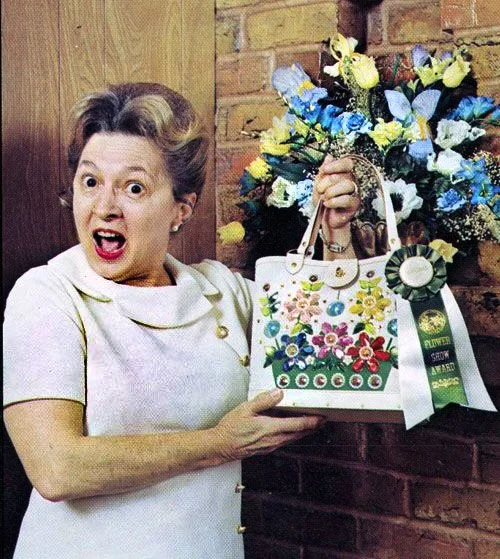
At Texas A&M, the Curriculum Calls for Collins
nearly 100 Original Enid Collins bags, accessories and vintage advertising pieces from the Collection travel to College Station, Texas, as part of a visionary floral art student exhibition
“College course” conjures up some typical notions for most people.
Tomes of dense reading. Rhetorical essays to draft and revise, and revise, and revise. Hours of hands-on work in a lab or studio to pursue an idea and practice skills under the critical eye of an exacting professor.
But it doesn’t make most of us think, “the study of purses.”
So, when Texas A&M University Asst. Prof. Wendy Osburn called last summer to ask if Finding Enid with Love would be willing to help her design a course around Enid Collins, we were a bit puzzled––not because we don’t see Enid’s work as worthy of academic study. We simply didn’t know what to make of Osburn’s particular discipline: floral design.
Wait. Floral design?
“The first time I heard the idea, it just didn’t make any sense to me,” says Finding Enid with Love Collection Manager and Curator Karen Adler. “I didn’t know that floral design is a serious discipline.”
Osburn directs Texas A&M’s quietly renowned Benz School of Floral Design, a go-to institution for floristry certification and continuing education housed in the university’s horticultural department. It’s also one of a handful of schools in the United States where undergraduates can earn professional certification.
Osburn, whose background encompasses fine art, art education, commercial floristry and ministry, leads the school with an approach that “seamlessly integrates science, structure and artistry into floral design.”
Texas A&M Asst. Prof. Wendy Osburn in the studio with floral design students in 2019.
Osburn wanted to use Enid’s work as a conceptual launchpad for “Horticulture 453: Floral Art,” an advanced course that approaches “floral design as an art form, in contrast to a commercial florist operation, [and stresses] interpretive expression of design principles and color… along with international design styles.”
She hit on the idea when a colleague dropped by her office with a vintage “flower box” bag she’d just unearthed on Etsy.
“I was like, ‘Oh my God, I could name all the ladies in church in Bryan [Texas] who had those purses every Sunday,’” Osburn says. “ Being a little girl who was into interiors and color, I always was mesmerized looking at the gems on the purses. I’d be standing up, looking in the pews when I probably should have been praying.”
“flower box” by Enid Collins (undated).
But what on earth would her class be doing? Making purses out of pansies? Stuffing roses into totes? It’s not hard to imagine fashion students studying Enid’s bags but “who would have thought about flowers?” Adler says.
“I have to explain to students that being a florist is an art career,” says Osburn. “It’s not just shoving flowers in a vase, which is sometimes what our department thinks we’re doing down here. We teach the elements and principles of design. We teach style. We teach theory. We teach about things out in the world. … It’s a different mindset.”
All college students have to attend lectures, hit the books, draft essays and cram for exams. When they study art, they do all of this and more.
The study of fine art requires a grasp of core principles, theories and methods in order to learn how to create representations, to get abstract thoughts out of our heads and onto a page, canvas or, in this case, three-dimensional space.
Osburn’s class studied Enid’s designs to understand seven fundamental art elements: line, form, space, size, pattern, color and texture. Floral art adds a challenging eighth, fragrance. They also studied principles such as balance, proportion, rhythm and unity.
Osburn used photos of hundreds of objects from the collection (plus two of her own Collins box bags) to challenge the class to think about how Enid used art elements to visualize concepts such as “transportation” and “fragrance,” or figurative turns of phrase such as “being a night owl” and “money doesn’t grow on trees.”
While this helped students break down the decision-making process that artists use when creating a piece, it also let them practice the adaptability they’ll need to meet the demands of real-world clients.
Though Osburn had confidence in her students, she admits that she had moments of doubt.
“Sometimes, you’re afraid, ‘Are they going to get what I’m feeling? Can they see the line in this? Can they see the elements of space?’” she says. “It’s a lot of faith. It’s a lot of their trusting me, and me trusting them.”
The students’ first challenge was to create their own box bags in the spirit of Enid.
The first assignment challenged each student to make their own box bag with a donated cigar-box “canvas” and media such as paint and ink, fabric, paper, wire, sequins and plastic jewels.
Next, they worked alone and in groups to design full-scale gallery installations based around each art element and inspired by Enid’s designs.
Working within constraints assigned by Osburn, such as specific color schemes and scale requirements, they crafted exhibits using a wide range of media, from permanent botanicals (the professional term for “artificial flowers”) and spray paint to play money and Popsicle sticks.
Osburn encouraged students to push past limits of what they thought they could achieve and stretch their creativity. “They had to look at all of the purses I chose, then come up with the elements.”
How did it go?
“They grabbed it,” she says. “For the students, this has been amazing. … I’m just so proud of their work.”
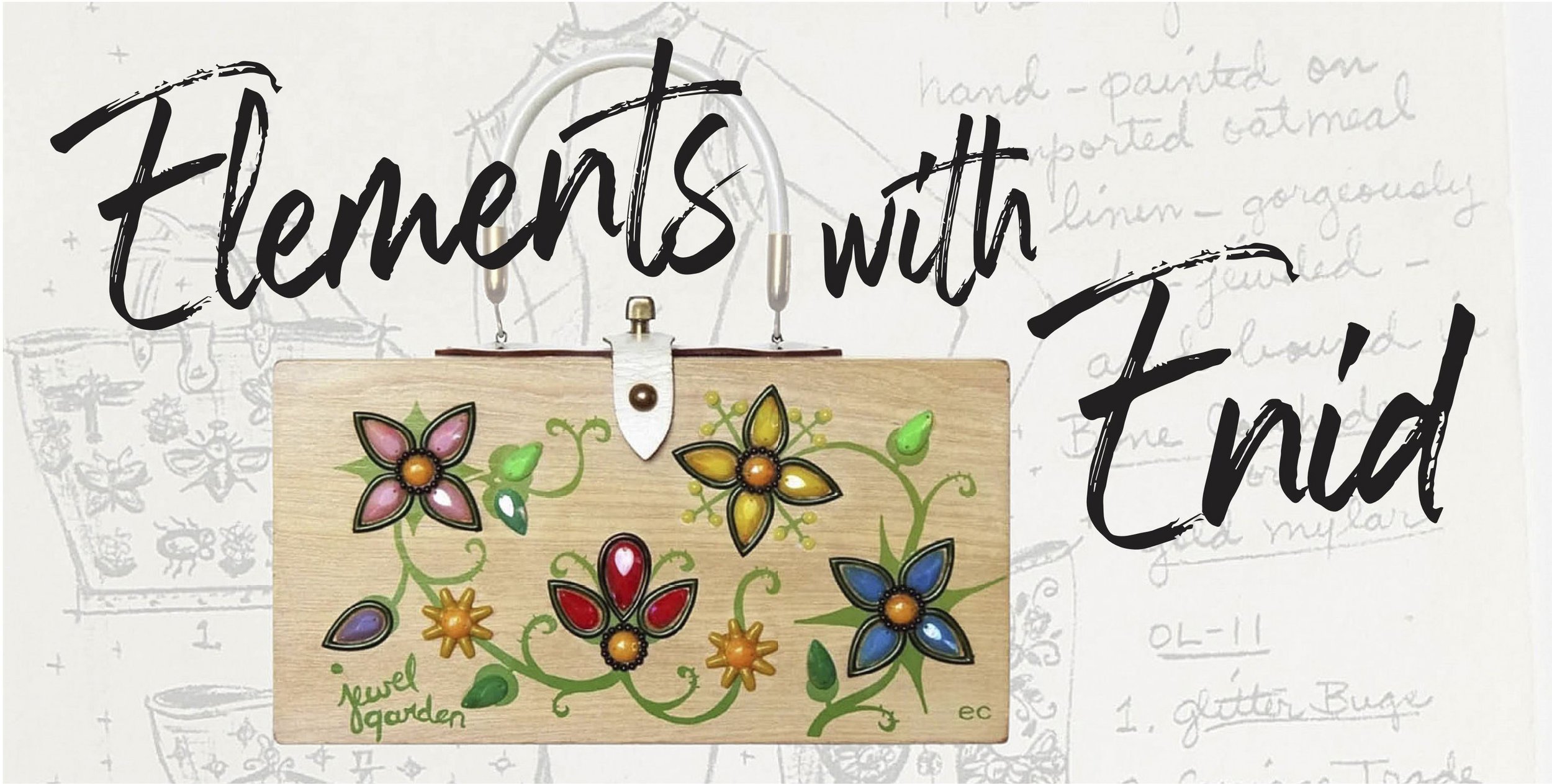
The Finding Enid with Love Collection loaned nearly 100 vintage Enid Collins bags and other objects to the Benz School and Texas A&M University Galleries for the culminating student show, "Elements with Enid: a floral perspective exhibition using the elements and principles of floral design to take a fresh look at Enid Collins” as an artist. The exhibition, which opened March 20 in the university’s Lindsay Gallery, includes handbags that span more than 50 years of fashion history and Enid's haute couture designs.
Collection Manager and Curator Karen Adler helps install original Enid Collins bags in the “Color Element” exhibit.
For months leading up to the opening, Adler meticulously prepared each object and assembled information about its artwork, materials and provenance, according to museum standards. She then flew to College Station to help with installation and meet the students. And, of course, to satisfy her curiosity about what Osburn and the budding floral artists had actually made.
“It’s just extraordinary, the talent of these students, the creativity that emerged through Wendy’s vision,” she says. “This exhibit rivals shows I’ve seen in some of the best museums in the U.S. and Europe.”
Students defended their works to a sold-out crowd, including Enid’s son Jeep Collins (third from left) and his family, and former American Institute of Floral Designers (AIFD) Board Vice Chair and Founder of Texas A&M Student AIFD Ken Senter with his wife, Donna (couple at right edge of audience).
Although a painter and former gallery owner, Adler had not closely analyzed Enid’s work for art elements until Osburn flew to Colorado last summer. Over the three days they worked together, Osburn conceiving themes around elements and Adler pulling purses to feed the process, she got a “Collins crash course” that taught her something new about Enid’s work each day (often 12 hours or more).
“I learned so much about the design elements of Enid’s art and came away with an even deeper appreciation for her as a fine artist,” she says, adding that the experience reinforced her appreciation for thinking beyond boundaries.
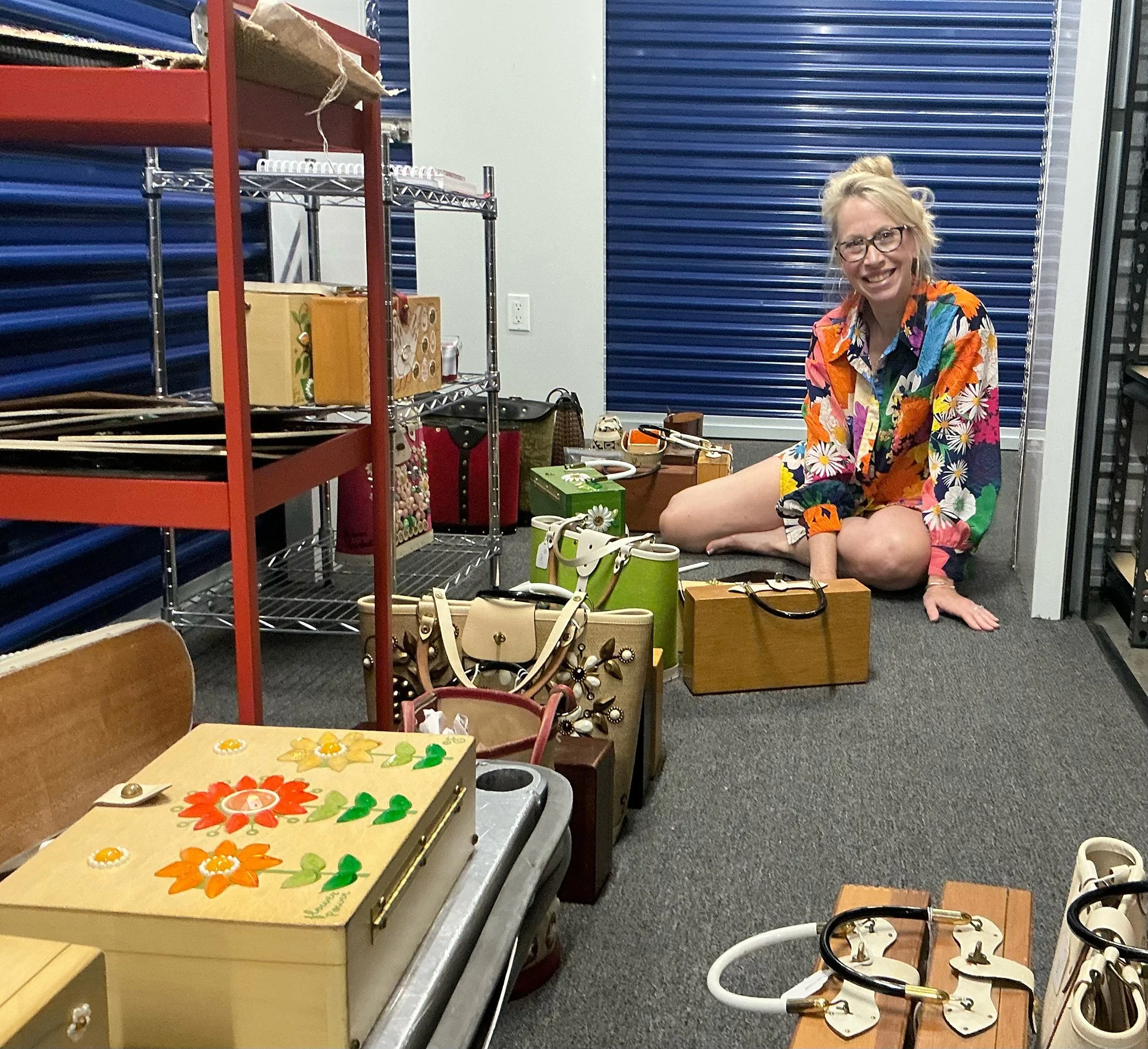
Osburn at work in the Collection in 2025.
“This combination of floral design and Enid’s bags is a great example of how important it is to blur lines, to collaborate and learn from each other across disciplines,” she says. “Something happens when you put two things together that don’t typically belong together. That’s what’s happening here, something new and exciting, because of that intersection.”
It all started with an Etsy find, a phone call from College Station and an inspired teacher.
“Wendy knew this was a great idea and she just did it,” Adler says. “It shows that Enid’s not stuck in history. Her work is still alive, and this is one way to acknowledge it.”